
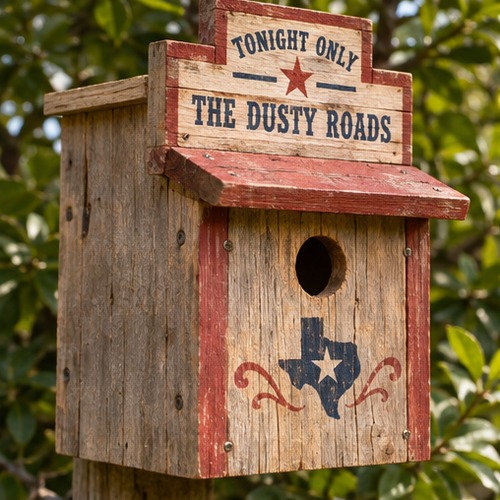
Bewick’s Wren · Reclaimed Wood
The Honky-Tonk
One false-front board gives this Texas dance hall its taller street-facing profile.
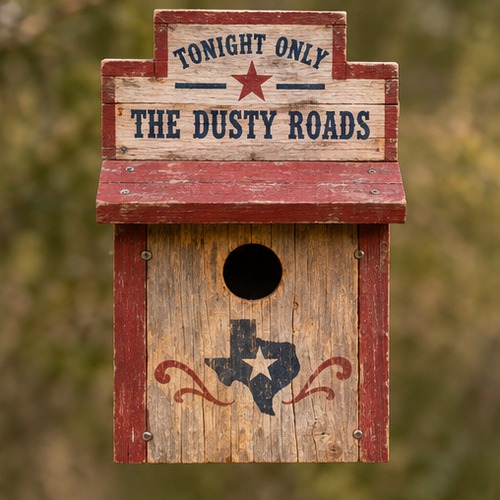
The Birdhouse
Tonight at the Honky-Tonk
One false-front board gives this Texas dance hall its taller street-facing profile. TONIGHT ONLY sets up the marquee, leaving room for the band that matters to you. The facade has the boldness of a hand-lettered sign outside a real music room.
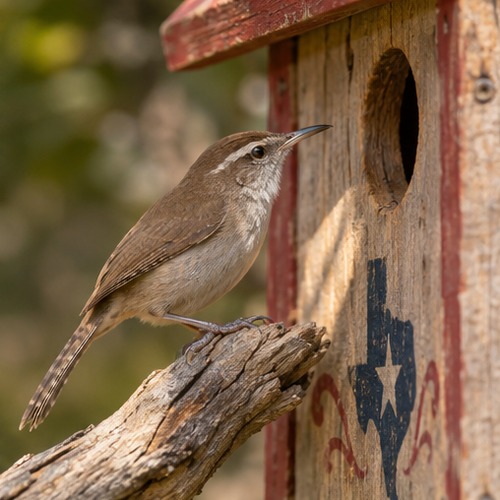
Stand back until the smaller lettering disappears. The outline and the broad blocks of color still tell you what you are looking at. Move closer and the brushwork and grain become visible. Reclaimed boards bring their own small variations in tone, so two versions of the same design can have a different surface under the paint. Underneath that familiar outline, the form is a cavity nest box intended for the Bewick’s Wren.
The Intended Bird
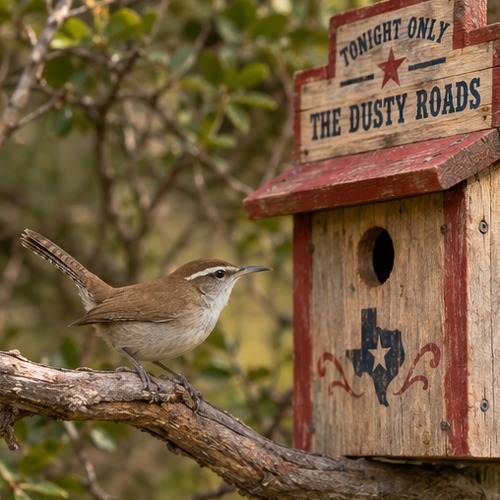
Meet the Bewick’s Wren
A long pale eyebrow and an expressive tail are useful clues. Watch low branches and brush piles for a slim brown bird slipping between stems and stopping to sing from a more exposed twig. A sheltered cavity close to brush suits a wren that spends much of the day hunting low. Nest material can include sticks, leaves and softer fibers gathered nearby.
An adult needs to enter with nest material, turn inside and leave again with a clear flight path. That sequence explains the simple face of this design. The paint gives people something to recognize from a distance while the actual chamber gives the bird a sheltered space. When choosing a site, picture the journey from a nearby perch all the way to the opening, including the last few feet.
The Landscape
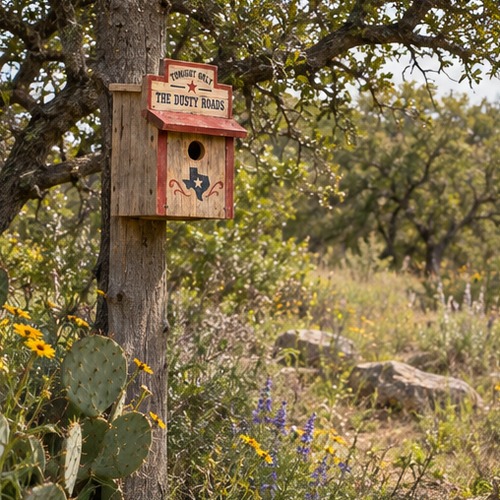
Range and Nesting Habitat
Where might you see the Bewick’s Wren? Mostly in western North America today, including western and central Texas and areas toward the Pacific Coast. Its distribution is patchy farther east. Choose scrub, brushy woodland edge or a yard connected to dense shrubs in an area with recent local records. Keep the opening free of branches that could block entry or admit a predator.
Check a breeding-season map before choosing a mounting point. A bird seen on a winter walk or during migration may spend the nesting months hundreds of miles away. Look at recent local observations from late spring or summer and compare the habitat around those sightings with your own property. The match becomes more convincing when both the season and the landscape line up.

The Handmade Detail
Who gets top billing?
Use a local band, an old stage name or a family ensemble. A short booking line reads well across a porch; save the longer story about the show for the person opening the gift.
Before settling on the final look of The Honky-Tonk, try writing the most important detail on a piece of paper at roughly the size you expect to see. Step back to the distance of your garden chair. Notice what you can still read and which colors disappear against the background. A photograph of the proposed spot helps when discussing the piece with the maker. Allow for differences in the reclaimed boards, especially where a dark grain line crosses a light painted area.
Field Notes
Watching the House Through the Season
A strongly delivered song may come from a bird hidden in surprisingly little cover. Wait at the edge of the brush and let the wren come into view in its own time.
Choose a seat from which you can see the entrance without standing in front of it. A few quiet minutes in the morning and another look toward evening can reveal different parts of the bird’s routine. If an adult waits with food or calls repeatedly while you are nearby, move farther away and let it resume its visits. For The Honky-Tonk, plan for an unobstructed view from a comfortable distance and leave the entrance quiet whenever birds are using it. Use the linked NestWatch guide to plan checks appropriate to the Bewick’s Wren.